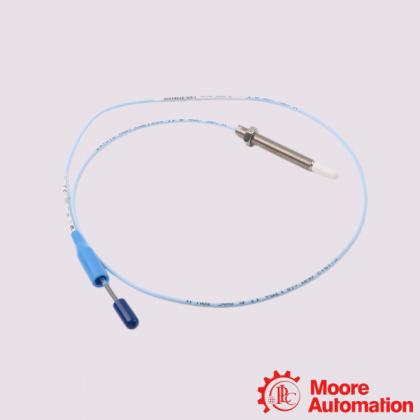
What is the SPASI23?
The SPASI23 is a 16-channel analog input module that belongs to the ABB Symphony Plus distributed control system family. It processes up to 16 analog field inputs simultaneously, with each channel equipped with a dedicated 24-bit analog-to-digital converter. The module handles input processing, calibration, point value calculations, lead wire resistance adjustment, cold junction compensation, gain and offset adjustment, and engineering unit conversion automatically. It is classified as a small equipment unit under WEEE Category 5 and carries HS code 85389081.
Why Choose the SPASI23?
The module supports 16 independently configured channels, each capable of accepting thermocouple types B, E, J, K, L, N (14 AWG and 28 AWG), R, S, T, and U, as well as Chinese type E and Chinese type S. It also handles three-wire RTD inputs including 10 ohm copper, 100 ohm platinum (U.S. Lab Standard, U.S. Industry Standard, and European Standard), 120 ohm nickel, and Chinese 53 ohm copper. High-level voltage spans from −10 VDC to +10 VDC, with additional ranges of 1 to 5 VDC, 0 to 5 VDC, and 0 to 10 VDC. Millivolt inputs cover −100 mV to +100 mV and 0 to 100 mV. This range of compatibility allows a single module to replace multiple specialized input cards, reducing hardware count and cabinet space in typical installations.
What Are the Key Features?
Each channel operates with a dedicated 24-bit ADC, providing finer measurement resolution than the 14-bit architecture found in comparable modules such as the SPFEC12. Input circuit offset, gain, and nonlinearity are captured during factory calibration and applied continuously during operation. The module also performs background recalibration to compensate for component aging and thermal drift without requiring manual intervention. Cold junction compensation for thermocouple inputs is handled through built-in references at each termination device, with the option to use a remote reference from another input on the same or a different I/O module. Engineering-unit conversion to degrees Celsius or Fahrenheit is computed automatically for all temperature sensor inputs using standard linearization tables. The module supports hot-swappable installation, allowing removal or insertion under power without system shutdown.
Parameters Specifications
|
Detailed Parameter |
Part Number:SPASI23 |
|
Power requirements |
+ 5 VDC, ± 5% at 500 mA typical |
|
Analog input channels |
16 independently configured channels |
|
Millivolt |
-100 mV to +100 mV, 0 to 100 mV |
|
Ambient temperature |
0 °C to 70 °C (32 °F to 158 °F) |
|
Product Type |
I-O_Module |
|
Channel Type |
AI |
|
Number of Input Channels |
16 |
|
Thermistors |
-50°C to +150°C |
|
Voltage |
-10 V to +10 V |
|
Current |
-20 mA to +20 mA |
|
Accuracy |
0.1% of full scale |
|
Conversion Time |
250 min |
|
Isolation |
2500 V RMS |
|
Power Consumption |
2.5 W |
The difference between SPFEC12 and SPASI23
|
|
||
|
Main functions |
Factory loop interface / communication control |
analog input acquisition. |
|
System Role |
Responsible for INFI-NET communication, connecting the host computer and control unit |
directly connects to industrial field sensors to collect data. |
|
Number of channels |
16 communication channels (management network node) without physical I/O |
analog input channels. |
|
Signal type |
Network communication protocol data |
Thermocouple (TC), millivolt (mV), resistance temperature detector (RTD), high-level signal. |
|
Location of use |
Typically installed in the system communication cabinet or management node. |
Installed on the I/O rack of the field process control unit (PCU). |
|
Primary Application |
Standard analog signal acquisition from field transmitters |
Temperature measurement (TC/RTD) + general analog signal acquisition |
|
Design Target |
Conventional transmitters and standard analog inputs |
Multi-signal types including temperature sensors |
Frequently Asked Questions
What input signal types can be configured per channel on the SPASI23?
Each of the 16 channels can be independently programmed for thermocouple types B, E, J, K, L, N (14 AWG and 28 AWG), R, S, T, and U, as well as Chinese type E and Chinese type S. Additional supported inputs include −100 to +100 mV, 0 to 100 mV, three-wire RTD (10, 100 U.S. Lab Standard, 100 U.S. Industry Standard, 100 European, 120 nickel, and Chinese 53 ohm copper), −10 to +10 VDC high-level voltage, 1 to 5 VDC, 0 to 5 VDC, and 0 to 10 VDC. Channel resolution and input type are selectable independently, permitting mixed-signal configurations on a single module.
Does the SPASI23 require periodic user calibration?
No. The module records input circuit offset, gain, and nonlinearity errors during a one-time factory calibration procedure. These measurements provide continuous error compensation during normal operation. Additionally, the module executes automatic recalibration in the background to offset component aging and temperature drift. No user-initiated calibration is necessary throughout the operational life of the device.
What modifications are needed when replacing an IMASI03 or IMASI13 with the SPASI23?
Hot Selling Recommendations
1756-EN2T
TI214
330500-03-04
IC200PWR002G
SPAJ140C
SPAJ140C
KJ4110X1-EA1
1734-4IOL
330102-00-43-05-02-05
330400-02-05
330180-50-00
Tel : +86 18030235313
Whatsapp & Wechat : +86 18030235313
Email : plcsale@mooreplc.com



 1 Year Warranty