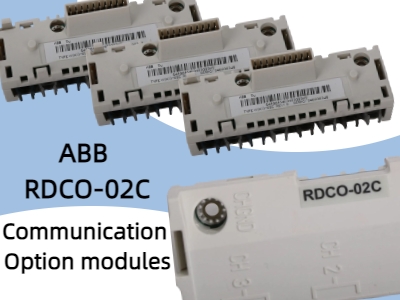
New Benchmark in Industrial Automation: ABB RDCO-02C Empowering the Upgrade of Smart Manufacturing
New Benchmark in Industrial Automation: ABB RDCO-02C Empowering the Upgrade of Smart ManufacturingJul 11, 2025
Global industries are accelerating digital transformation, demanding controllers that merge intelligence with operational resilience. ABB’s engineering breakthrough – the RDCO-02C – redefines automation excellence for next-generation production ecosystems.
1. The RDCO-02C: Next-Gen Industrial Control Architecture ABB’s innovation transcends conventional controllers, delivering an integrated automation nucleus. This system-on-chip platform merges computational intensity with industrial ruggedness, engineered for mission-critical applications.
Core technological distinctions: Sub-millisecond decision cycles for dynamic process adjustment Native interoperability across legacy and modern fieldbus systems Power-optimized silicon architecture reducing thermal footprint Containerized software deployment for agile function updates
Its hardened construction withstands extreme temperatures and electromagnetic interference common in heavy industrial zones. 2. Smart Manufacturing Enablement Framework The controller serves as the neural hub for Industry 4.0 implementations through: Anomaly forecasting via continuous vibration/thermal pattern analysis Closed-loop optimization self-adjusting production parameters in real-time Cybersecurity-by-design with hardware-encrypted communications Carbon accounting integration quantifying sustainability impact
This transforms static production lines into self-optimizing value streams responsive to market fluctuations.
3. Operational Transformation Metrics Deployment yields quantifiable business outcomes: 57% reduction in unplanned line stoppages (automotive sector case) 22% decrease in energy intensity per production unit 3× acceleration in changeover procedures Predictable maintenance windows cutting spare part inventories by 40%
These translate to 18-24 month ROI periods across documented installations.
4. Cross-Industry Implementation Vectors Strategic deployment scenarios include: Electronics: Microsecond-precision placement machinery calibration Chemical Processing: Reaction vessel safety interlocks with SIL3 certification Logistics Hubs: High-speed sortation system synchronization Water Treatment: Predictive pump failure avoidance in remote facilities Early adopters report 99.998% operational availability in continuous-process environments.
Benchmarks show 40% faster signal processing versus comparable industrial PCs.
Conclusion: The Automation Evolution Catalyst ABB’s technological statement through the RDCO-02C establishes a new paradigm where control systems actively drive business outcomes rather than merely enabling processes. Its fusion of deterministic performance with intelligent adaptability makes it indispensable for competitive manufacturing.
Stuck in a critical breakdown situation? Moore Automation provides a myriad of services to clients across the globe. Contact us today to find out how our experienced team can help you minimise downtime.



 1 Year Warranty